-
Shop
- Advanced Technologies
- AI Skills Mastery 2026 Collection
- Beauty
- Beauty & Skincare
- Best-Sellers
- Calvin Klein
- Car Accessories
- Car Buying & Ownership
- Dating & Social Confidence
- Dating & Social Skills
- Denim
- 7FOR
- AGOLDE
- Antony Morato
- Armani Exchange
- Boss
- Brunello Cucinelli
- Calvin Klein Jeans
- Costume National
- Desigual
- Diesel
- Dolce & Gabbana
- Dsquared²
- Ermanno Scervino
- Fendi
- Gianni Lupo
- Guess Jeans
- Ichi
- Just Cavalli
- Lee
- Levi's
- Liu Jo
- Morgan De Toi
- Mother Denim
- Only
- Pepe Jeans
- Pinko
- Replay
- Tommy Hilfiger Jeans
- Valentino
- Vero Moda
- Digital Resources
- Education & Learning
- Family & Parenting
- Fashion
- Alexander McQueen
- Bags & Wallets
- Balenciaga
- Belts
- Bottega Veneta
- Brunello Cucinelli
- Burberry
- Chanel
- Chloé
- Dior
- Dolce & Gabbana
- Etro
- Fendi
- Gucci
- Hats & Hair Accessories
- Jacquemus
- Jewelry
- Jil Sander
- Jimmy Choo
- Keychains
- Kiton
- Miu Miu
- Off-White
- Prada
- Rick Owens
- Saint Laurent
- Shoes
- Socks & Tights
- Sunglasses
- The Row
- Tom Ford
- Valentino
- Valentino Garavani
- Versace
- Vivienne Westwood
- Watches
- Fashion & Style
- Fashion Accessories
- Finance & Career
- Financial Education
- Find Your Path Collection
- Fitness
- Fitness & Movement
- Furniture
- Gadgets
- Health & Beauty
- Health & Wellness
- Home & Garden
- Home & Kitchen
- Home & Lifestyle
- Home Styling & Organization
- Home Supplies
- Hormone & Women’s Health
- Kids & Babies
- Kitchen
- Lighting
- Mindset & Personal Growth
- Nike
- Online Business
- Online Business for Beginners
- Parenting
- Patio, Lawn & Garden
- Personal Growth
- Pet Care
- Pet Supplies
- Pets
- Self-Care & Mental Well-Being
- Sleep & Rest
- Smart Life with IA
- Sport & Outdoors
- Style & Fashion
- Super Deals
- Travel
- Wealth
- Wealth Building
- Wellness
- YouTube Shorts Best-Sellers
- Popular
- Best deals
Reframe Anxious Thoughts Without Dismissing Your Feelings

How can I reframe anxious thoughts without invalidating my feelings?
Start by separating the feeling from the story your mind is telling. Anxiety can be a real, body-level signal (“I feel unsafe” or “I feel pressured”) while the thought attached to it may be exaggerated (“This will be a disaster” or “I can’t handle this”). Reframing doesn’t require you to pretend you’re fine—it helps you respond to the feeling with a more accurate, useful interpretation.
A practical way to reframe while honoring what you feel
1) Name the emotion and validate it. Try: “I’m feeling anxious, and that makes sense because this matters to me.” Validation isn’t agreement with worst-case thoughts; it’s acknowledging your experience.
2) Identify the anxious thought, word-for-word. Write it down: “If I mess up, everything will fall apart.” Getting specific makes it easier to evaluate.
3) Look for the thinking pattern, not a “mistake.” Anxiety often leans on catastrophic thinking, mind-reading, or all-or-nothing rules. Recognizing the pattern reduces shame and creates distance.
4) Ask two grounding questions. “What evidence supports this?” and “What evidence doesn’t?” You’re not debating your feelings—you’re checking the forecast your mind is making.
5) Build a bridge thought (not a forced positive). A bridge thought is believable even when you’re anxious. Examples:
- Instead of “I can’t cope,” try “This is hard, and I can take one step at a time.”
- Instead of “It will go terribly,” try “There’s uncertainty, but I’ve handled tough situations before.”
- Instead of “I must do it perfectly,” try “I can aim for solid, not perfect.”
6) Pair the reframe with a small action. Anxiety eases faster when thoughts and behavior align. Choose one next step: send the email draft, set a timer for 10 minutes, or ask one clarifying question.
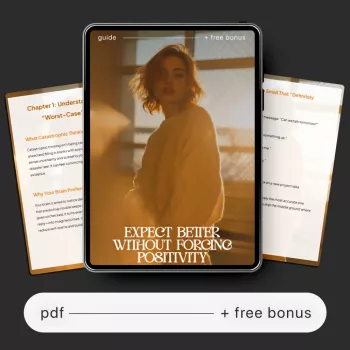
For a deeper walkthrough of bridge thoughts and how to shift catastrophic thinking without dismissing your emotions, visit this guide on reframing anxiety and catastrophic thinking.
FAQ
What’s the difference between reframing and toxic positivity?
Reframing keeps the hard feelings in the picture while adjusting the interpretation to something more accurate and helpful. Toxic positivity skips over pain and pushes you to “just be positive,” which can increase shame and tension.














Leave a comment