-
Shop
- Advanced Technologies
- AI Skills Mastery 2026 Collection
- Beauty
- Best-Sellers
- Calvin Klein
- Car Accessories
- Car Buying & Ownership
- Dating & Social Confidence
- Dating & Social Skills
- Denim
- 7FOR
- AGOLDE
- Antony Morato
- Armani Exchange
- Boss
- Brunello Cucinelli
- Calvin Klein Jeans
- Costume National
- Desigual
- Diesel
- Dolce & Gabbana
- Dsquared²
- Ermanno Scervino
- Fendi
- Gianni Lupo
- Guess Jeans
- Ichi
- Just Cavalli
- Lee
- Levi's
- Liu Jo
- Morgan De Toi
- Mother Denim
- Only
- Pepe Jeans
- Pinko
- Replay
- Tommy Hilfiger Jeans
- Valentino
- Vero Moda
- Digital Resources
- Education & Learning
- Family & Parenting
- Fashion
- Alexander McQueen
- Bags & Wallets
- Balenciaga
- Belts
- Bottega Veneta
- Brunello Cucinelli
- Burberry
- Chanel
- Chloé
- Dior
- Dolce & Gabbana
- Etro
- Fendi
- Gucci
- Hats & Hair Accessories
- Jacquemus
- Jewelry
- Jil Sander
- Jimmy Choo
- Keychains
- Kiton
- Miu Miu
- Off-White
- Prada
- Rick Owens
- Saint Laurent
- Shoes
- Socks & Tights
- Sunglasses
- The Row
- Tom Ford
- Valentino
- Valentino Garavani
- Versace
- Vivienne Westwood
- Watches
- Fashion & Style
- Fashion Accessories
- Financial Education
- Find Your Path Collection
- Fitness
- Furniture
- Gadgets
- Health & Beauty
- Health & Wellness
- Home & Garden
- Home & Kitchen
- Home Styling & Organization
- Home Supplies
- Kids & Babies
- Kitchen
- Lighting
- Nike
- Online Business
- Online Business for Beginners
- Parenting
- Patio, Lawn & Garden
- Personal Growth
- Pet Care
- Pet Supplies
- Pets
- Smart Life with IA
- Sport & Outdoors
- Super Deals
- Travel
- Wealth
- Wealth Building
- Wellness
- YouTube Shorts Best-Sellers
- Popular
- Best deals
Stop Overthinking: A Bridge-Thought Reframe for Anxiety
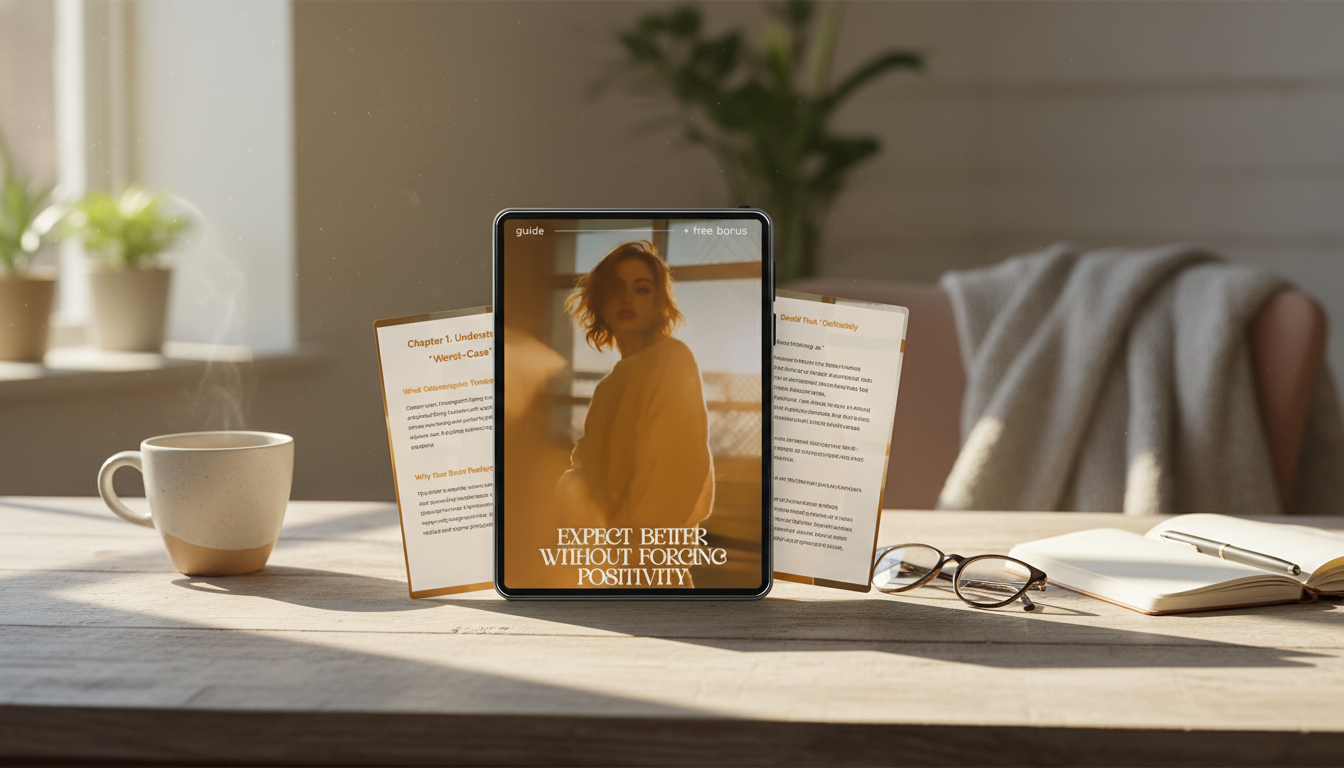
Expect Better Without Forcing Positivity: A Practical Reframe Guide for Overthinking and Catastrophic Thoughts
When anxiety turns everyday uncertainty into worst-case stories, “just think positive” can feel like pressure—especially when the fear feels real. A more sustainable approach is expecting better without denying hard feelings: noticing the mental pattern, interrupting it, and choosing a more balanced next thought. The goal isn’t constant optimism; it’s steadier self-talk and a repeatable way to shift out of spirals when your mind is overworking.
Why forced positivity can backfire during anxiety
Forced positivity often skips the step of acknowledging what feels unsafe, which can make the worry return louder. If your nervous system is sounding an alarm, overly cheerful statements can feel unrealistic—and that mismatch can trigger more internal debate, not less.
Anxiety also tends to demand certainty. So when a thought like “Everything will be fine” collides with “But what if it isn’t?” you can end up in a tug-of-war that burns energy and reinforces the original fear. A more helpful approach is: validate the emotion, name the thought pattern, then choose a grounded reframe that still allows hope.
Expecting better doesn’t mean pretending there’s no risk. It means leaving room for a good outcome, while staying honest about what you can and can’t control—an approach that aligns with cognitive-behavioral principles used to challenge unhelpful thinking patterns (see American Psychological Association – Cognitive Behavioral Therapy (CBT)).
The pattern-shift method: from spiral to steady
This method is designed to work with a busy mind rather than arguing it into submission. Think of it as a quick sequence that moves you from “alarm” to “stable enough to choose the next step.”
Step 1 — Notice the cue
Common cues include body tension, doom-scrolling, checking for reassurance, mental replay, or persistent “what if” loops. The cue is your signal to shift gears early rather than waiting for the spiral to peak.
Step 2 — Label the pattern
Give the thought a category: catastrophizing, mind-reading, fortune-telling, all-or-nothing thinking, or over-responsibility. Labeling creates a little distance—enough to respond rather than react.
Step 3 — Name the need underneath
Under the thought is usually a need: safety, reassurance, control, clarity, rest, or connection. When the need is named, your next move becomes more practical (and less self-critical).
Step 4 — Reframe with a bridge thought
A bridge thought is believable. It doesn’t jump to “everything is perfect.” It softens the certainty of the worst-case story: “This is hard, and I have options.”
Step 5 — Choose one next action (under 10 minutes)
Pick something specific and doable: write a quick plan, message a friend, step outside for two minutes, drink water, or set a timer and do one small task. Action helps your brain register that you’re not trapped.
| Pattern | What it sounds like | Bridge reframe | Next small step |
|---|---|---|---|
| Catastrophizing | “If this goes wrong, everything falls apart.” | “This could be hard, but one setback won’t define the whole story.” | Write the most likely outcome and one backup plan. |
| Fortune-telling | “I already know how this will end.” | “I don’t have the full data yet; I can wait to decide.” | Set a decision time and pause rumination until then. |
| Mind-reading | “They must be disappointed in me.” | “I’m guessing—better to ask or look for evidence.” | Draft a simple clarifying message. |
| All-or-nothing | “If it’s not perfect, it’s a failure.” | “A decent result still counts; progress is not binary.” | Pick the “good enough” version and do 10 minutes. |
| Over-responsibility | “It’s all on me to prevent problems.” | “I can influence things, not control everything.” | List what’s in/out of control and act on one item. |
Self-talk that lowers alarm without ignoring reality
When your nervous system is activated, short phrases usually work better than long debates. Aim for reassurance that feels credible, not flashy.
If anxiety feels frequent or intense, learning more about symptoms and treatment options can help you choose supports that fit (see National Institute of Mental Health – Anxiety Disorders).
Reframe prompts for overthinking loops
Using the guide as a quick reset or a daily practice
Quick reset (3–5 minutes)
Daily practice (10 minutes)
Pair thought work with body support
What’s inside “Expect Better Without Forcing Positivity”
If you want a structured format you can pull up the moment a spiral starts, Expect Better Without Forcing Positivity – Anxiety Reframe Guide (digital download) is built around the pattern-shift steps above, with repeatable prompts and self-talk scripts designed to feel realistic (not performative).
At-a-glance details
| Format | Best for | Use time | Delivery |
|---|---|---|---|
| Digital download eBook | Overthinking, catastrophic thinking, anxiety-driven spirals | 3–10 minutes per use | Instant access after purchase |
Supportive add-ons for calmer routines
For a small, consistent cue at your desk or bedside, the Mini USB Aroma Humidifier & Essential Oil Diffuser with Soft LED Light can pair well with the pattern-shift method: you notice the cue (tension), label the pattern, and add a calming sensory signal while you choose your bridge thought. Keep the focus on consistency over intensity—small daily supports often work better than occasional big resets.
FAQ
How is this different from positive thinking?
It uses believable bridge thoughts and validates emotions instead of insisting you feel upbeat. The focus is balanced reframes and practical next steps, not pretending everything is fine.
Can this help with catastrophic thinking at night?
Yes—use a short routine: label the pattern, write the most likely outcome, choose one next step for tomorrow, and then add a calming cue (slower breathing, dim light, or a consistent bedtime signal) to reduce arousal.
Is this a substitute for therapy?
No. It’s a self-guided support tool; consider professional help for persistent distress, panic, trauma, or any safety concerns.















Leave a comment