-
Shop
- Advanced Technologies
- AI Skills Mastery 2026 Collection
- Best-Sellers
- Calvin Klein
- Car Accessories
- Car Buying & Ownership
- Dating & Social Skills
- Denim
- 7FOR
- AGOLDE
- Antony Morato
- Armani Exchange
- Boss
- Brunello Cucinelli
- Calvin Klein Jeans
- Costume National
- Desigual
- Diesel
- Dolce & Gabbana
- Dsquared²
- Ermanno Scervino
- Fendi
- Gianni Lupo
- Guess Jeans
- Ichi
- Just Cavalli
- Lee
- Levi's
- Liu Jo
- Morgan De Toi
- Mother Denim
- Only
- Pepe Jeans
- Pinko
- Replay
- Tommy Hilfiger Jeans
- Valentino
- Vero Moda
- Digital Resources
- Education & Learning
- Family & Parenting
- Fashion
- Alexander McQueen
- Bags & Wallets
- Balenciaga
- Belts
- Bottega Veneta
- Brunello Cucinelli
- Burberry
- Chanel
- Chloé
- Dior
- Dolce & Gabbana
- Etro
- Fendi
- Gucci
- Hats & Hair Accessories
- Jacquemus
- Jewelry
- Jil Sander
- Jimmy Choo
- Keychains
- Kiton
- Miu Miu
- Off-White
- Prada
- Rick Owens
- Saint Laurent
- Shoes
- Socks & Tights
- Sunglasses
- The Row
- Tom Ford
- Valentino
- Valentino Garavani
- Versace
- Vivienne Westwood
- Watches
- Fashion & Style
- Fashion Accessories
- Financial Education
- Find Your Path Collection
- Fitness
- Furniture
- Gadgets
- Health & Beauty
- Health & Wellness
- Home & Garden
- Home & Kitchen
- Home Styling & Organization
- Home Supplies
- Kids & Babies
- Kitchen
- Lighting
- Nike
- Online Business
- Online Business for Beginners
- Parenting
- Patio, Lawn & Garden
- Personal Growth
- Pet Care
- Pet Supplies
- Pets
- Smart Life with IA
- Sport & Outdoors
- Super Deals
- Travel
- Wealth
- Wealth Building
- Wellness
- YouTube Shorts Best-Sellers
- Popular
- Best deals
Montessori Counting Sticks: Easy Math Play for Kids
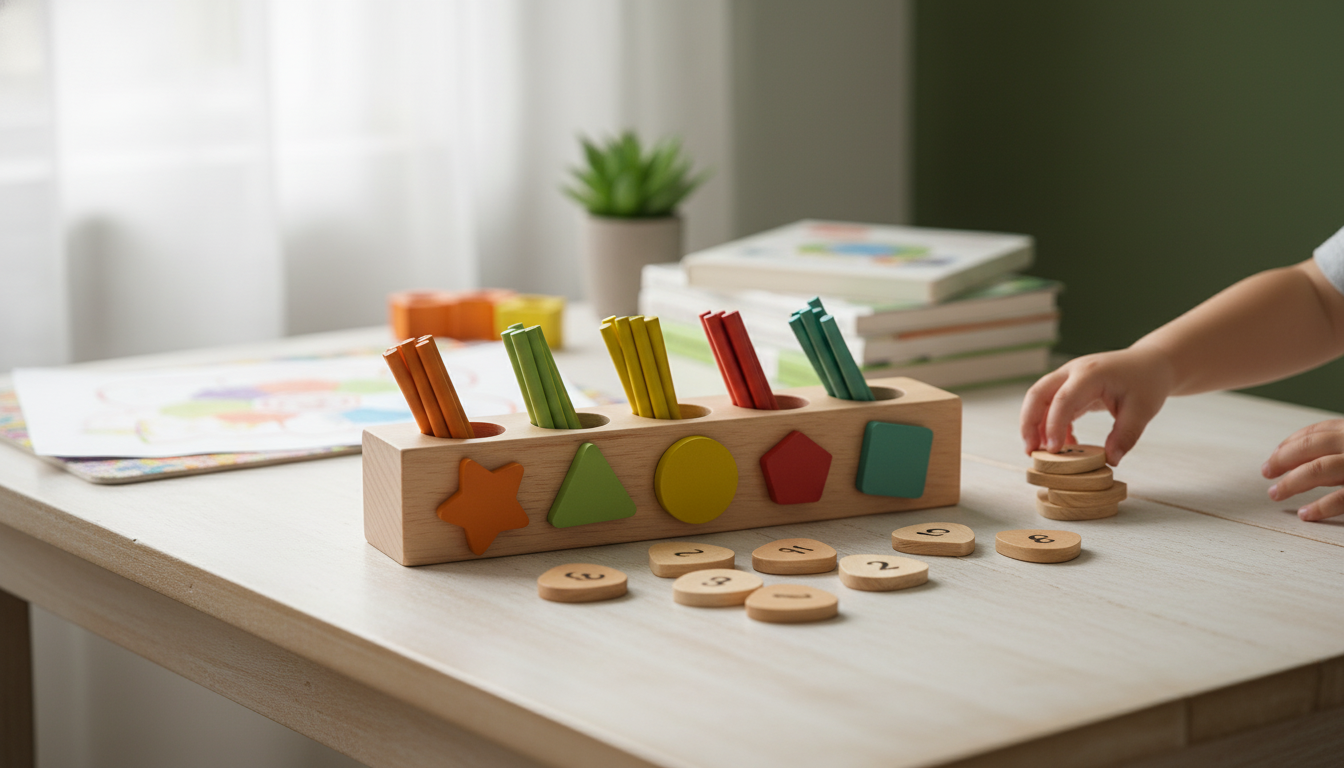
Montessori Wooden Counting Stick Toys: Hands-On Number Learning for Little Learners
Wooden counting sticks offer a simple, tactile way for children to explore numbers through touch, movement, and repetition. This type of Montessori-inspired material supports early math understanding by making quantity, order, and basic operations visible and concrete—especially helpful for preschool and early elementary ages. With a small set of sticks and a few calm, repeatable activities, children can practice core number skills in a way that feels like play while still building real confidence.
What Counting Sticks Help Children Learn
Counting sticks turn “numbers on a page” into something a child can hold, move, and check. That physical feedback matters when kids are still learning what numbers actually mean.
- One-to-one correspondence: touching one stick per count builds accurate counting habits.
- Number sense: understanding that “5” represents a set of five items, not just a symbol.
- Comparisons: more/less, longer/shorter sets, and “how many more to make 10.”
- Early operations: combining sets (addition) and taking away (subtraction) using physical objects.
- Fine-motor practice: grasping, placing, aligning, and sorting supports hand control for writing.
Skills Supported by Common Counting Stick Activities
| Activity | What the child does | Skills reinforced |
|---|---|---|
| Count and place | Moves one stick at a time while saying numbers aloud | Stable counting order, one-to-one correspondence |
| Make a number | Builds sets (e.g., 7 sticks) to match a numeral card or spoken prompt | Quantity recognition, numeral-quantity connection |
| Compare sets | Builds two piles and identifies which has more/less | Magnitude, comparison language |
| Add together | Combines two sets and recounts the total | Addition concept, recounting strategies |
| Take away | Removes sticks from a set and counts what remains | Subtraction concept, part–whole thinking |
| Build to 10/20 | Adds sticks until reaching a target number | Number bonds, counting-on |
Why Wooden, Open-Ended Materials Fit Montessori-Inspired Play
Montessori-aligned learning often starts with the concrete and gradually moves toward the abstract. Counting sticks fit this beautifully because they’re simple, flexible, and easy for children to control.
- Concrete to abstract learning: children manipulate real objects before working with symbols.
- Self-correcting opportunities: miscounts become visible when sets don’t match the target.
- Focus and simplicity: fewer distractions than flashing or sound-making toys.
- Durability and routine: wood holds up well to repeated daily practice and classroom-style use.
- Independence: children can choose an activity, complete it, and reset the work area.
For more on Montessori principles and why hands-on materials matter, the Association Montessori Internationale is a helpful reference.
Age Guidance and Readiness Signs
Many children enjoy counting sticks during the preschool-to-kindergarten window, but the best starting point is based on readiness, not a strict birthday milestone.
- Typical starting window: around ages 3–6 for basic counting and quantity work (varies by child).
- Earlier exposure: toddlers can sort by color or place sticks into a container under close supervision.
- Readiness signs: interest in counting, lining objects up, recognizing small quantities, following short instructions.
- Progression: move from counting small sets (1–5) to larger sets (1–10, then 1–20) and simple operations.
If you’re wondering what’s typical at different ages, the CDC child development milestones page can provide broad guidance (while remembering that individual development varies).
At-Home Activities Using Counting Sticks
A little structure goes a long way. Choose one activity at a time, keep sessions calm, and let your child repeat favorites until the steps feel automatic.
- Count-and-match: say a number and have the child build the set with sticks.
- Number line building: place sticks in groups to represent 1 through 10 in order.
- Odd/even discovery: make two equal rows from a set; a leftover stick shows an odd number.
- Simple word problems: “You have 4 sticks and get 2 more—how many now?”
- Sort and pattern: create repeating patterns (AB, AAB) using colors or stick types if included.
- Speed-free practice: focus on accuracy and calm repetition rather than timed drills.
To support independence, try setting the sticks on a small tray or placemat. A defined workspace makes it easier to “see” the set and reset when finished.
Safety, Materials, and Care Tips
Because counting sticks are handled frequently and sometimes used by younger siblings nearby, it’s worth building simple safety habits from the start.
For general play safety reminders, the American Academy of Pediatrics toy safety guidance is a solid resource.
Using Montessori Wooden Counting Stick Toys in Daily Routines
Featured Learning Tools (In Stock)
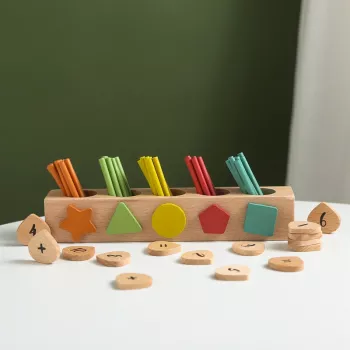
Montessori Wooden Counting Stick Toys
Montessori Wooden Counting Stick Toys
Quick Product Snapshot
| Item | Price | Availability | Link |
|---|---|---|---|
| Montessori Wooden Counting Stick Toys | 14.51 USD | In stock | View product |
| Losing Body Fat Percentage eBook | Complete Guide on how to lose body fat percentage, Nutrition, Workouts & Lifestyle Strategies for Sustainable Fat Loss | 15.99 USD | In stock | View product |
| Helping Teens Build Healthy Connections in a Digital World – eBook Guide on how to help teens build healthy friendships, Teen Communication & Social Skills Resource | 23.99 USD | In stock | View product |
FAQ
What age is appropriate for wooden counting sticks?
Many children start using counting sticks for early math around ages 3–6, depending on attention span and interest. Younger toddlers may use them for supervised sorting or placing activities, while older preschoolers can move into counting and simple operations.
How do counting sticks support early math beyond rote counting?
They build one-to-one correspondence and help children see that a numeral represents a real quantity. Sticks also make comparisons (more/less) and number bonds visible, and combining or removing sticks introduces the core ideas behind addition and subtraction.
How should wooden counting sticks be cleaned and stored?
Wipe sticks with a slightly damp cloth, avoid soaking the wood, and let everything dry fully before putting it away. Inspect for cracks or rough edges, and store in a tray or pouch so children can set up and clean up independently.














Leave a comment