-
Shop
- Advanced Technologies
- AI Skills Mastery 2026 Collection
- Best-Sellers
- Calvin Klein
- Car Accessories
- Car Buying & Ownership
- Dating & Social Skills
- Denim
- 7FOR
- AGOLDE
- Antony Morato
- Armani Exchange
- Boss
- Brunello Cucinelli
- Calvin Klein Jeans
- Costume National
- Desigual
- Diesel
- Dolce & Gabbana
- Dsquared²
- Ermanno Scervino
- Fendi
- Gianni Lupo
- Guess Jeans
- Ichi
- Just Cavalli
- Lee
- Levi's
- Liu Jo
- Morgan De Toi
- Mother Denim
- Only
- Pepe Jeans
- Pinko
- Replay
- Tommy Hilfiger Jeans
- Valentino
- Vero Moda
- Digital Resources
- Education & Learning
- Family & Parenting
- Fashion
- Alexander McQueen
- Bags & Wallets
- Balenciaga
- Belts
- Bottega Veneta
- Brunello Cucinelli
- Burberry
- Chanel
- Chloé
- Dior
- Dolce & Gabbana
- Etro
- Fendi
- Gucci
- Hats & Hair Accessories
- Jacquemus
- Jewelry
- Jil Sander
- Jimmy Choo
- Keychains
- Kiton
- Miu Miu
- Off-White
- Prada
- Rick Owens
- Saint Laurent
- Shoes
- Socks & Tights
- Sunglasses
- The Row
- Tom Ford
- Valentino
- Valentino Garavani
- Versace
- Vivienne Westwood
- Watches
- Fashion & Style
- Fashion Accessories
- Financial Education
- Find Your Path Collection
- Fitness
- Furniture
- Gadgets
- Health & Beauty
- Health & Wellness
- Home & Garden
- Home & Kitchen
- Home Styling & Organization
- Home Supplies
- Kids & Babies
- Kitchen
- Lighting
- Nike
- Online Business
- Online Business for Beginners
- Parenting
- Patio, Lawn & Garden
- Personal Growth
- Pet Care
- Pet Supplies
- Pets
- Smart Life with IA
- Sport & Outdoors
- Super Deals
- Travel
- Wealth
- Wealth Building
- Wellness
- YouTube Shorts Best-Sellers
- Popular
- Best deals
No-Tears Math at Home: Daily Checklist for Kids
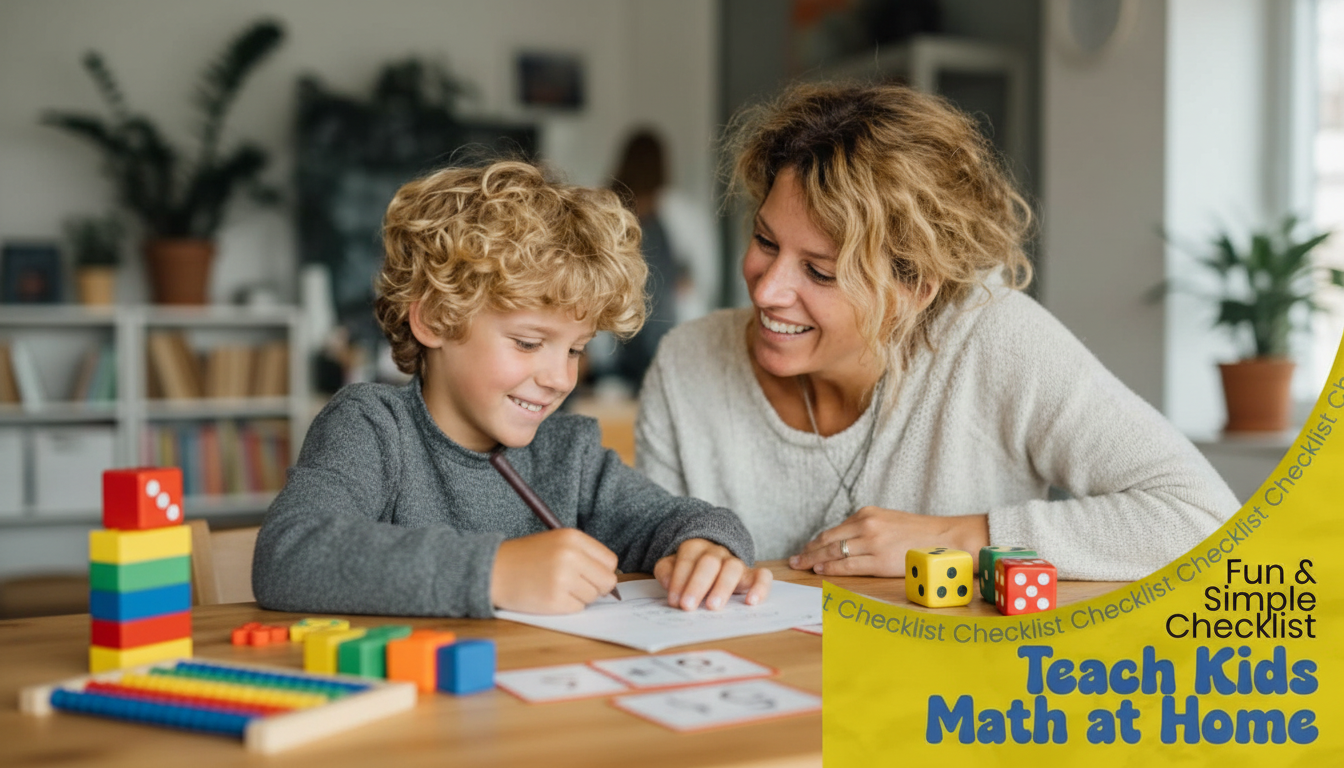
Fun & Simple Checklist to Teach Kids Math at Home Without Tears
Math at home can feel like a daily battle when lessons move too fast, confidence is low, or practice turns into pressure. A simple, consistent routine—plus a few playful strategies—can make math calmer and more effective for parents and homeschoolers. Use the checklist below to build skills step by step, reduce frustration, and keep progress visible.
Start With the Right Setup (5 minutes that saves the whole lesson)
A predictable setup lowers stress for both of you and helps your child’s brain switch into “learning mode” faster.
- Pick a consistent time window: 10–25 minutes for younger kids; 20–40 minutes for older kids. Aim to end on success (even if it means stopping early).
- Create a “math spot”: pencil, scratch paper or a small whiteboard, a few manipulatives (coins, blocks, beads), plus a timer.
- Use a calm opening script: “Today is one small skill. Mistakes are clues.” Repeating the same words helps reduce anticipation anxiety.
- Remove distractions: one device only if it’s the learning tool; notifications off; extra tabs closed.
- Track progress visually: sticker chart, skill ladder, or a short checklist that gets checked off daily.
Quick Check: Find the Exact Skill Gap
Frustration often comes from practicing the wrong level. A fast “micro-check” helps you pinpoint the precise breakdown so practice actually works.
- Ask 3–5 problems at the level your child should already know. Stop as soon as confusion shows up.
- Name the gap in plain language: “place value,” “borrowing,” “fact fluency,” “fractions on a number line.”
- Do a teach-back: have your child explain one problem out loud. If they can explain it, they likely understand it.
- Keep it to one gap per session: stacking gaps creates overwhelm and resistance.
If you want research-aligned guidance for math instruction and interventions, the What Works Clearinghouse is a helpful starting point for finding evidence-based practices.
The No-Tears Math Session Checklist (printable routine)
Consistency beats intensity. This routine keeps sessions short, focused, and emotionally safe—without lowering expectations.
- Warm-up (2–3 minutes): one easy win (counting, quick facts, or a familiar puzzle).
- Mini-lesson (5–10 minutes): teach one method using concrete objects → drawings → numbers (CPA progression).
- Guided practice (5–10 minutes): solve 3–6 problems together and talk through each step.
- Independent try (3–7 minutes): 2–4 problems solo; step in only after an honest attempt.
- Review (2 minutes): child explains the strategy; write one takeaway (“Today I learned…”).
- Close with confidence: stop before fatigue and praise effort + strategy, not speed.
| Step | Time | What to Do | Signs It’s Working |
|---|---|---|---|
| Warm-up | 2–3 min | One easy win (skip counting, quick facts, math game round) | Child starts without dread; quick success |
| Mini-lesson | 5–10 min | Teach one skill using objects → drawings → numbers | Fewer “I don’t get it” moments |
| Guided practice | 5–10 min | Solve a small set together; model thinking out loud | Child can predict next step |
| Independent try | 3–7 min | Short solo attempt; allow productive struggle | At least 1–2 correct with explanation |
| Review + close | 2 min | Explain strategy; note one takeaway; end on success | Child can describe what changed today |
Make Math Feel Like Play (without losing rigor)
Play isn’t the opposite of learning—it’s often the fastest path to fluency and flexible thinking when you keep it short and purposeful.
- Use real-life math: cooking (fractions), shopping (estimation and decimals), sports stats (averages and comparisons).
- Turn practice into mini-games: dice addition, card multiplication, a fraction scavenger hunt in the pantry.
- Add movement: hopscotch number lines or “solve and shoot” (one basket attempt after each correct answer).
- Swap worksheets for micro-practice: 5 great problems beat 30 rushed ones.
- Celebrate strategies: “You broke the number apart,” “You checked your work,” “You tried a second method.”
For more guidance on strong math teaching principles and mathematical thinking, the National Council of Teachers of Mathematics (NCTM) offers family-friendly perspectives alongside educator resources.
Prevent Tears Before They Start: Common Triggers and Fixes
A Simple Weekly Plan for Parents and Homeschoolers
If screens become part of your routine, having family communication tools can reduce conflict and keep devices from turning into a daily tug-of-war. The American Academy of Pediatrics Media and Children Communication Toolkit includes practical ideas for setting boundaries and talking with kids.
A Ready-to-Use Checklist Resource
- Fun & Simple Checklist: Teach Kids Math at Home Without Tears! | Easy Guide on how to teach kids math at home for Parents & Homeschoolers ($29.99)
- Helping Teens Build Healthy Connections in a Digital World – eBook Guide on how to help teens build healthy friendships, Teen Communication & Social Skills Resource ($23.99)
FAQ
How long should a math lesson at home be?
For younger kids, aim for 10–25 minutes; for older kids, 20–40 minutes usually works well. Use a timer and stop before fatigue so the session ends with a win and your child wants to come back tomorrow.
What if my child cries or shuts down during math?
Pause and acknowledge the feeling, then drop to an easy problem to rebuild safety and confidence. Bring out concrete tools (coins, blocks, a number line) and restart with one small skill in a shorter session.
Do timed math drills help or hurt?
Timed drills can help some kids build speed, but they can raise anxiety for others and make mistakes worse. Focus on strategy-based fluency first, then use brief timing only when your child is already accurate and confident.
Recommended for you


First Paycheck Plan for Teens: Save, Spend, Give
Jun 3, 2026













Leave a comment