-
Shop
- Advanced Technologies
- AI Skills Mastery 2026 Collection
- Best-Sellers
- Calvin Klein
- Car Accessories
- Car Buying & Ownership
- Dating & Social Skills
- Denim
- 7FOR
- AGOLDE
- Antony Morato
- Armani Exchange
- Boss
- Brunello Cucinelli
- Calvin Klein Jeans
- Costume National
- Desigual
- Diesel
- Dolce & Gabbana
- Dsquared²
- Ermanno Scervino
- Fendi
- Gianni Lupo
- Guess Jeans
- Ichi
- Just Cavalli
- Lee
- Levi's
- Liu Jo
- Morgan De Toi
- Mother Denim
- Only
- Pepe Jeans
- Pinko
- Replay
- Tommy Hilfiger Jeans
- Valentino
- Vero Moda
- Digital Resources
- Education & Learning
- Family & Parenting
- Fashion
- Alexander McQueen
- Bags & Wallets
- Balenciaga
- Belts
- Bottega Veneta
- Brunello Cucinelli
- Burberry
- Chanel
- Chloé
- Dior
- Dolce & Gabbana
- Etro
- Fendi
- Gucci
- Hats & Hair Accessories
- Jacquemus
- Jewelry
- Jil Sander
- Jimmy Choo
- Keychains
- Kiton
- Miu Miu
- Off-White
- Prada
- Rick Owens
- Saint Laurent
- Shoes
- Socks & Tights
- Sunglasses
- The Row
- Tom Ford
- Valentino
- Valentino Garavani
- Versace
- Vivienne Westwood
- Watches
- Fashion & Style
- Fashion Accessories
- Financial Education
- Find Your Path Collection
- Fitness
- Furniture
- Gadgets
- Health & Beauty
- Health & Wellness
- Home & Garden
- Home & Kitchen
- Home Styling & Organization
- Home Supplies
- Kids & Babies
- Kitchen
- Lighting
- Nike
- Online Business
- Online Business for Beginners
- Parenting
- Patio, Lawn & Garden
- Personal Growth
- Pet Care
- Pet Supplies
- Pets
- Smart Life with IA
- Sport & Outdoors
- Super Deals
- Travel
- Wealth
- Wealth Building
- Wellness
- YouTube Shorts Best-Sellers
- Popular
- Best deals
Beat Solo Burnout: Printable Checklist for Daily Focus

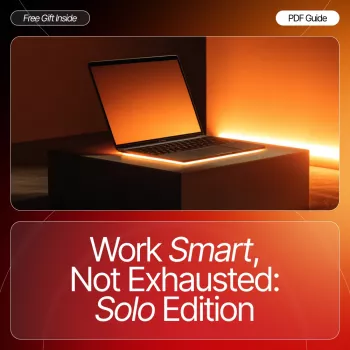
Work Smart, Not Exhausted (Solo Edition): A Printable Checklist to Stay Productive Without Burning Out
Working alone can feel like carrying every role—creator, manager, marketer, support—without a clear finish line. The hardest part isn’t always the workload; it’s the constant switching, deciding, and self-managing that quietly drains energy. Burnout isn’t just “being tired,” either. The World Health Organization describes burnout as a work-related syndrome tied to chronic workplace stress that hasn’t been successfully managed—often showing up as exhaustion, mental distance, and reduced effectiveness.
This guide breaks solo burnout down into practical signals, daily guardrails, and a simple routine that protects energy while keeping momentum. The centerpiece is a printable checklist designed to make “enough for today” visible, repeatable, and easier to stick to.
Why solo work drains faster than expected
Solo work can look flexible on paper, but it often feels intense in practice because the workload is only half the story. The other half is the mental overhead.
- Context switching replaces deep work: frequent pivots between client needs, admin tasks, and creative output increase mental load and make it harder to reach “flow.”
- No natural stopping cues: without a team schedule, boundaries blur and work can expand into evenings and weekends.
- Invisible labor piles up: invoicing, proposals, follow-ups, planning, and tool maintenance consume energy even when they don’t feel like “real work.”
- Decision fatigue compounds: constant prioritizing, pricing, and problem-solving reduces willpower for the work that matters most.
- Isolation reduces recovery: fewer social breaks can make stress feel heavier and more personal.
Stress also shows up physically. The American Psychological Association notes that stress can affect the body in wide-ranging ways, from sleep disruption to tension and immune changes—exactly the kind of “mystery symptoms” that can sneak up during busy seasons.
Early signs of burnout when working alone
Burnout doesn’t always arrive with flashing warning lights. It often starts as subtle friction—work that used to feel manageable begins to feel oddly heavy.
- Productivity looks busy but results slow down: more hours, fewer finished deliverables.
- Small tasks feel disproportionately hard: replying to emails, starting a draft, or organizing files becomes exhausting.
- Irritability and detachment: clients feel “annoying,” and meaningful projects feel pointless.
- Sleep changes: trouble falling asleep, waking early to “mentally work,” or needing long recovery naps.
- Body cues: headaches, stomach issues, tight shoulders/jaw, or frequent colds.
- Reward avoidance: finishing something doesn’t feel satisfying—only relief.
If these are showing up consistently, it’s a sign your system needs guardrails, not more willpower. For more on job stress and its impact, the CDC’s NIOSH overview is a solid reference: Stress at Work (NIOSH).
A sustainable solo workflow: three guardrails that prevent exhaustion
Guardrails are pre-made decisions that protect your energy on days when motivation is low and demands are high. The goal is to stay productive without turning every day into a test of endurance.
- Guardrail 1 — Define “done for today”: set a concrete end condition (time + output) to prevent work from expanding.
- Guardrail 2 — Protect one recovery block daily: a non-negotiable 20–60 minutes for movement, meal, sunlight, or a quiet reset.
- Guardrail 3 — Limit priority lanes: keep one primary focus and one secondary focus per day; everything else becomes “later” or delegated.
Solo workday guardrails (simple defaults)
| Guardrail | Default rule | What it prevents |
|---|---|---|
| Done for today | Stop at a set time or after 1–2 deliverables | Endless tweaking and late-night spirals |
| Recovery block | Schedule a daily reset (walk, meal, stretch, silence) | Running on adrenaline until a crash |
| Priority lanes | 1 main goal + 1 support task | Overcommitment and scattered attention |
| Communication window | Check messages 1–3 times/day | Reactive work taking over the schedule |
How the “Work Smart, Not Exhausted: Solo Edition” checklist fits into real life
The best routine is the one you’ll actually follow when you’re busy. A printable checklist helps by making the key decisions quick, concrete, and repeatable.
- Turns vague stress into a repeatable routine: a short set of prompts you can use daily or weekly.
- Balances output and self-care without guilt: includes checkpoints that keep rest from becoming optional.
- Creates a visible plan for the day: reduces decision fatigue by narrowing what matters now.
- Works for mixed schedules: helpful for freelancers juggling multiple clients and entrepreneurs switching between building and selling.
- Designed for printing and quick reference: use on a clipboard, in a planner, or pinned near your workspace.
If you want a simple, ready-to-print framework, start with Work Smart, Not Exhausted: Solo Edition (Printable Checklist). It’s built to make your boundaries visible—so you don’t have to renegotiate them all day.
A 10-minute daily reset using the checklist
This reset is designed for real life: short, structured, and flexible enough for shifting client needs.
On high-stress weeks, pairing your checklist with a basic health routine can make the difference between steady output and a crash. If you’re also rebuilding energy through nutrition and training habits, Losing Body Fat Percentage eBook can support more consistent lifestyle structure—especially when your schedule is self-directed.
Preventing the most common solo-work traps
Who this printable is best for (and when it helps most)
FAQ
How do solo entrepreneurs avoid burnout without working fewer hours?
Reduce energy leaks: limit priorities to one main goal, timebox admin, define a clear end-of-day condition, and schedule a daily recovery block so rest doesn’t get pushed to “later.”
Is a printable checklist actually helpful if everything changes day to day?
Yes, because it standardizes the decisions that stay the same—priorities, communication windows, recovery, and shutdown—while leaving the specific tasks flexible.
How often should the checklist be used?
Use it daily for quick planning and shutdown, plus a weekly review to reset priorities and capacity. Increase frequency during launches or high-stress periods.
Recommended for you

No-Tears Math at Home: Daily Checklist for Kids
Jun 3, 2026













Leave a comment